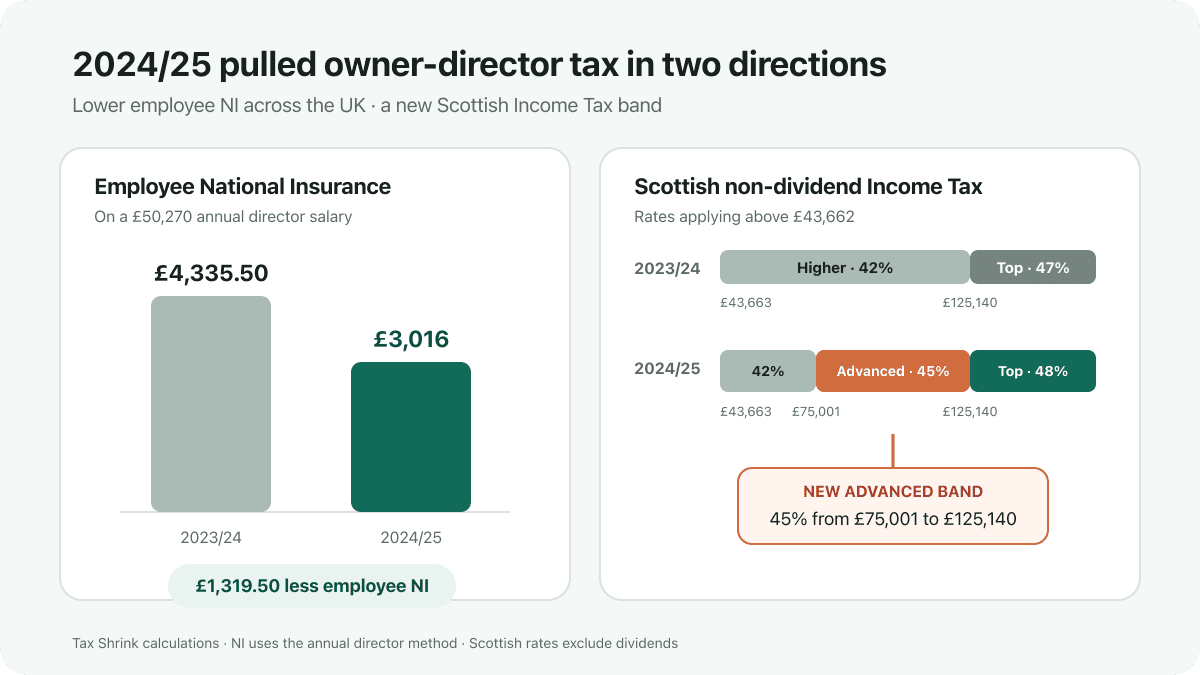
The 2024/25 tax year pulled a salary-and-dividend calculation in opposite directions. The employee NI rate fell, but the dividend allowance halved and Scotland introduced a sixth salary Income Tax band.
The figures cover 6 April 2024 to 5 April 2025 and assume a sole owner-director of a straightforward UK limited company taking salary and dividends. Scottish salary tax is shown separately because Scotland introduced a sixth Income Tax band.
The £1,319.50 employee NI reduction
The Spring Budget 2024 reduced the main employee Class 1 National Insurance rate from 10% to 8% from 6 April 2024. The rate above the Upper Earnings Limit remained 2%. This followed the earlier cut from 12% to 10% in January 2024.
Using HMRC's annual thresholds and Category A director rates:
| Tax year | Main-band employee NI calculation | Employee NI |
|---|---|---|
| 2023/24 | (£50,270 − £12,570) × 11.5% |
£4,335.50 |
| 2024/25 | (£50,270 − £12,570) × 8% |
£3,016.00 |
That is £1,319.50 less employee National Insurance in the simplified annual comparison. It isolates the employee deduction; it does not show the company's employer NI cost, the Corporation Tax effect or the reduction in dividends.
The Spring Budget 2024 (opens in new tab) and HMRC's 2024/25 employer rate tables (opens in new tab) record the change.
The NI saving met a smaller dividend allowance
The UK-wide dividend allowance fell from £1,000 to £500. Rates above the allowance remained 8.75% in the basic band, 33.75% in the higher band and 39.35% in the additional band.
For £10,000 of dividends falling wholly within the basic dividend band:
- 2023/24 tax:
(£10,000 − £1,000) × 8.75% = £787.50; - 2024/25 tax:
(£10,000 − £500) × 8.75% = £831.25; - increase: £43.75.
Real dividend tax depends on the salary and other income below it. The £500 allowance still occupies band capacity, so it cannot be deducted before deciding which dividend rate applies.
Read what the £500 Dividend Allowance actually saves for the nil-rate-band explanation and examples at each dividend rate.
The cut affected only the employee side. At the same £50,270 salary, a company unable to claim Employment Allowance still
faced £5,681.46 of employer NI: (£50,270 − £9,100) × 13.8%. Salary remained deductible for Corporation Tax, so the
useful comparison was the combined company-and-director result rather than the £1,319.50 saving on its own.
Scotland changed the answer at higher salaries
England, Wales or Northern Ireland kept the 20%, 40% and 45% salary Income Tax rates. Scotland introduced a 45% Advanced rate above £75,000 and raised its Top rate from 47% to 48% above £125,140. Its lower bands widened slightly, so the effect was not simply “every Scottish taxpayer paid more”.
Worked example: £50,000 salary only
With the full Personal Allowance and no other income, the Income Tax bill was approximately:
- £7,486.00 in England, Wales or Northern Ireland;
- £9,028.31 in Scotland.
At this salary, the Scottish bill was about £10.17 lower than under the 2023/24 Scottish schedule because the lower bands widened. The new Advanced and Top rates did not affect a £50,000 salary. The position depended on which bands the salary actually reached, not on Scotland's highest headline rate.
Scottish rates apply to salary as non-savings, non-dividend income. Dividend rates, National Insurance, Personal Allowance and Corporation Tax remain UK-wide. The correct region follows the taxpayer; see HMRC's who-pays guidance (opens in new tab) if a move or more than one home makes the answer uncertain.
The dedicated Scottish director salary and dividend guide reproduces the £50,000 comparison band by band and shows how UK-wide dividends follow Scottish salary.
Put the NI headline in context
If you were considering a salary near £50,270, the employee NI saving was only one line of the calculation. Enter the company's expected profit in the salary-and-dividend optimiser, choose the director's region, and compare the total tax and take-home result. The personal-tax comparison isolates the regional effect on salary and dividends.
Tax Shrink's core calculation assumes a sole director who cannot claim Employment Allowance. If that does not describe the company, check the tax-rate reference and methodology before using the result. Payroll timing and other personal income also need separate treatment.
Official sources
- HMRC: Income Tax rates and allowances, current and previous years (opens in new tab)
- HM Treasury: Spring Budget 2024 (opens in new tab)
- HMRC: National Insurance changes from 6 April 2024 (opens in new tab)
- HMRC: employer rates and thresholds for 2024/25 (opens in new tab)
- Scottish Government: Scottish Income Tax 2024/25 (opens in new tab)
Continue the series
- Previous: UK director tax changes in 2023/24.
- Next: UK director tax changes in 2025/26, when employer National Insurance became the dominant new cost for many one-person companies.