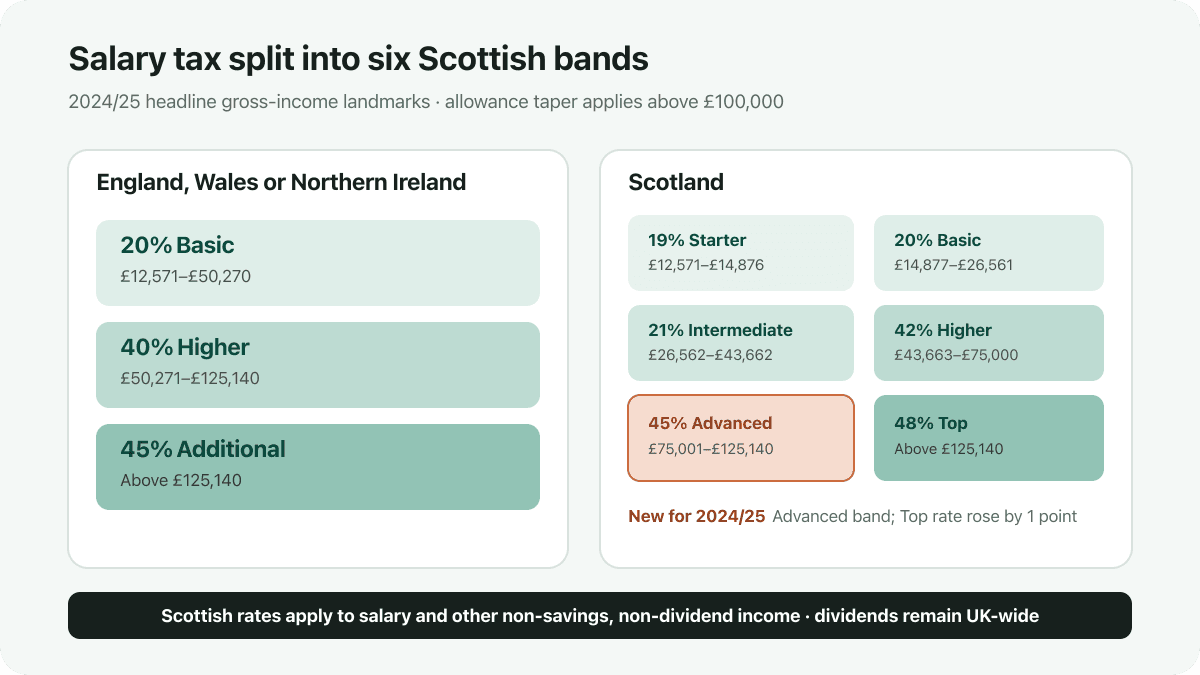
At a £50,000 annual salary with the full Personal Allowance, the 2024/25 Income Tax bill was £7,486 in England, Wales or Northern Ireland and £9,028.31 in Scotland. The Scottish bill was £1,542.31 higher before National Insurance.
The difference did not come from the new 45% Advanced rate, because £50,000 was below that threshold. It came from Scotland's existing Starter, Basic, Intermediate and Higher bands, including a 42% Higher rate beginning at a lower salary than the 40% rate elsewhere in the UK. The new Advanced band made the divergence larger at higher salaries.
Scotland moved to six salary-tax rates
The Scottish Budget for 2024/25 introduced an Advanced rate of 45% for income above £75,000 and increased the Top rate from 47% to 48% above £125,140. The Starter, Basic, Intermediate and Higher rates stayed at 19%, 20%, 21% and 42%.
For a person receiving the standard £12,570 Personal Allowance, the gross salary landmarks were:
| 2024/25 gross salary range | Scotland | England, Wales or Northern Ireland |
|---|---|---|
| £12,571–£14,876 | 19% Starter | 20% Basic |
| £14,877–£26,561 | 20% Basic | 20% Basic |
| £26,562–£43,662 | 21% Intermediate | 20% Basic |
| £43,663–£50,270 | 42% Higher | 20% Basic |
| £50,271–£75,000 | 42% Higher | 40% Higher |
| £75,001–£125,140 | 45% Advanced | 40% Higher |
| Above £125,140 | 48% Top | 45% Additional |
These gross-income ranges assume the full Personal Allowance and no other non-savings, non-dividend income. Above £100,000, the allowance tapers away by £1 for each £2 of adjusted net income, so a simple gross threshold table stops being sufficient.
The Scottish Government published the 2024/25 rates and bands (opens in new tab) after its 19 December 2023 Budget announcement. The eventual schedule applied from 6 April 2024.
Reproducing the £50,000 example
With no other income and the full £12,570 Personal Allowance, £50,000 of salary leaves £37,430 taxable.
For England, Wales or Northern Ireland, that entire amount remained within the £37,700 Basic rate band:
£37,430 × 20% = £7,486
For Scotland, the same taxable salary crossed four bands:
| Scottish band | Taxable amount | Calculation | Tax |
|---|---|---|---|
| Starter | £2,306 | £2,306 × 19% | £438.14 |
| Basic | £11,685 | £11,685 × 20% | £2,337 |
| Intermediate | £17,101 | £17,101 × 21% | £3,591.21 |
| Higher | £6,338 | £6,338 × 42% | £2,661.96 |
| Total | £37,430 | £9,028.31 |
Employee National Insurance was the same in both regions. The example isolates Income Tax and does not claim that a £50,000 salary is sensible remuneration for a particular company.
Dividends did not become Scottish dividends
Scottish rates apply to non-savings, non-dividend income. For most owner-directors, salary is the relevant part. Dividends continue to use UK-wide ordinary, upper and additional dividend rates.
That does not make region irrelevant to the dividend bill. Income is ordered for tax purposes, with salary positioned before dividends. A Scottish salary calculation can therefore leave a different amount of band capacity for the UK-wide dividend income that follows.
Imagine two directors with identical salary and dividends, one Scottish and one in England. Their dividend rates are drawn from the same UK schedule, but their salary tax differs. Depending on the amounts and allowances, the salary can also affect where the dividends land. Comparing only the headline dividend percentage misses that interaction.
The personal-tax calculator shows the salary and dividend bands separately. Change the site-wide region and the salary calculation updates while the configured dividend rates remain UK-wide.
The later 2026/27 dividend-tax guide explains the UK-wide rate increase without treating Scottish salary bands as dividend bands.
The taxpayer's region matters, not the company's address
A company registered in Edinburgh does not make every director a Scottish taxpayer. Equally, a company registered in England can have a Scottish taxpayer as its director.
HMRC determines Scottish taxpayer status from the individual's circumstances, principally where the person lives. Scottish PAYE tax codes normally begin with S, but a tax code is an indicator rather than a substitute for resolving a move or multiple-home case. HMRC's Scottish taxpayer guidance (opens in new tab) explains the tests.
Tax Shrink asks for one of two Income Tax regions: Scotland, or England, Wales or Northern Ireland. It does not infer a region from an IP address, company address or postcode. If the correct status is uncertain, settle that question with HMRC or a qualified adviser before relying on the regional comparison.
Why this mattered to salary planning
For a straightforward owner-director, salary affects both sides of the calculation. The company can normally deduct salary and employer National Insurance when calculating taxable profit. The individual can face Income Tax and employee National Insurance. The remaining distributable profit may then be paid as a dividend.
Scotland's extra salary bands changed one part of that chain, not all of it. A fixed salary copied from an England-focused article could therefore produce a different Scottish take-home result, especially once salary moved beyond £43,662 and later £75,000.
Use the salary and dividend calculator for the supported one-director scenario, and inspect the tax-rate page when a band edge explains a change. Savings, property, pensions, benefits in kind and other employment income remain outside the model; the methodology lists the full boundaries.
The wider 2024/25 retrospective explains how the Scottish change coincided with lower employee National Insurance and a smaller Dividend Allowance.