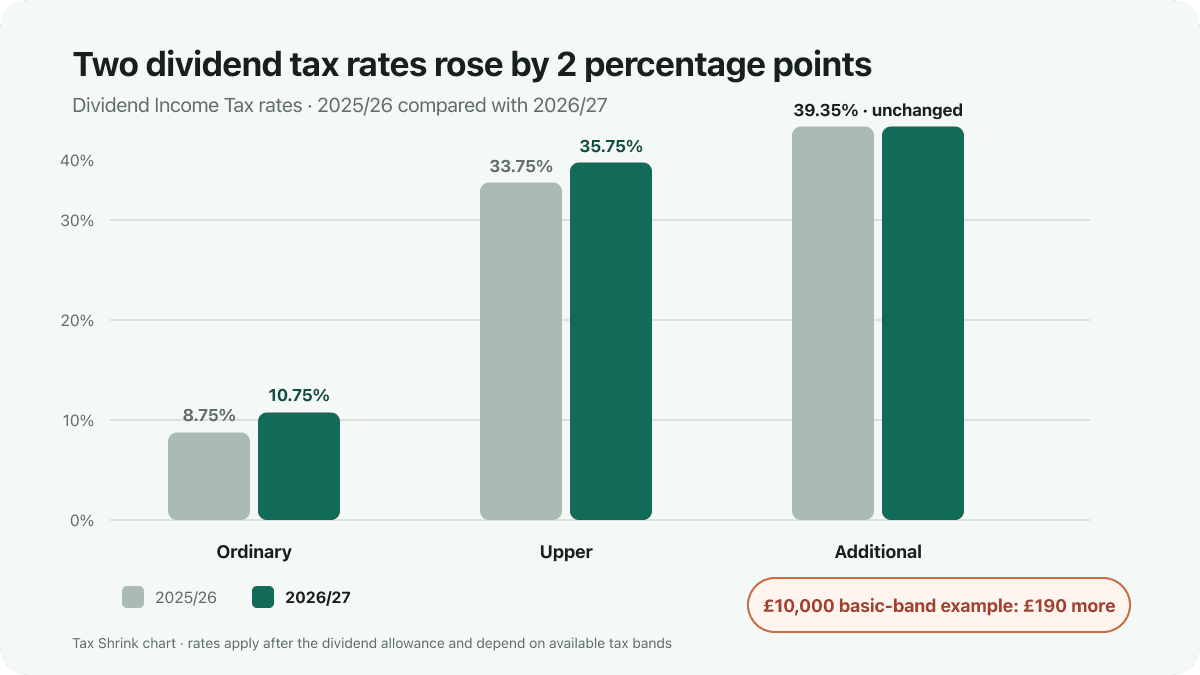
A £10,000 gross dividend can produce a £190 increase: when the £500 Dividend Allowance is available and the Personal Allowance has already been used, £9,500 is charged at an affected rate and £9,500 × 2% is £190.
A £10,000 already taxable dividend can produce a £200 increase: when the full amount is charged at the ordinary or upper rate, £10,000 × 2% is £200. Both answers are correct; they use different bases and assume the amount remains in one affected band in both tax years.
See the full 2026/27 owner-director tax roundup for National Insurance, Corporation Tax and Scottish salary Income Tax alongside this dividend-rate change.
Gross, allowance and taxable: three different figures
- Gross dividend is the full dividend declared and received before personal tax.
- Dividend Allowance charges up to £500 of dividend income at 0%. It is not a deduction from total income and does not create extra tax-band capacity; the income still counts when working out which band later dividends occupy.
- Taxable dividend, in the examples below, means the amount charged at the ordinary, upper or additional dividend rate after any available 0% allowance. Unused Personal Allowance can change that amount too.
The £500 allowance is not always available in full. Other dividends in the same tax year may have used some or all of it, and salary or other income can move a dividend across rate bands.
The £500 Dividend Allowance guide explains why the allowance does not expand the basic-rate band.
What changed on 6 April 2026
The ordinary and upper dividend rates rose by two percentage points; the additional rate and Dividend Allowance did not change:
| Dividend rate | 2025/26 | 2026/27 | Change per £1,000 charged in the band |
|---|---|---|---|
| Ordinary | 8.75% | 10.75% | £20 more |
| Upper | 33.75% | 35.75% | £20 more |
| Additional | 39.35% | 39.35% | No change |
These rates apply UK-wide. The government published the change in its Budget 2025 tax legislation overview (opens in new tab), and HMRC's current and previous Income Tax rates (opens in new tab) show the enacted 2026/27 schedule.
Worked ordinary, upper and additional-rate outcomes
Assume first that a £10,000 gross dividend uses the still-available £500 Dividend Allowance, the Personal Allowance is already fully used and the remaining £9,500 stays wholly within the ordinary band:
- 2025/26: £9,500 × 8.75% = £831.25
- 2026/27: £9,500 × 10.75% = £1,021.25
- increase: £190
Now assume the allowance has already been used, so a £10,000 already taxable dividend remains wholly within one band:
| Band containing the full £10,000 | 2025/26 tax | 2026/27 tax | Increase |
|---|---|---|---|
| Ordinary | £875 | £1,075 | £200 |
| Upper | £3,375 | £3,575 | £200 |
| Additional | £3,935 | £3,935 | £0 |
These examples isolate the rate change. A dividend crossing a boundary needs a band-by-band calculation, not one rate applied to the whole amount.
Salary and region determine where dividends sit
Non-savings income such as salary is positioned before dividends. It can use the Personal Allowance and basic-rate band before the dividend calculation begins. Two directors receiving the same gross dividend can therefore owe different tax when their salary or other income differs.
Scottish Income Tax rates apply to non-savings, non-dividend income such as salary and pensions. Dividend rates remain UK-wide, but Scottish salary bands can leave a different amount of UK-wide band capacity for the dividends that follow. The tax-rate page keeps the regional salary schedules separate from the shared dividend schedule.
Tax Shrink's personal-tax calculator shows the band-by-band personal result. The salary and dividend calculator also includes employer National Insurance and Corporation Tax for the supported single-director company scenario.
Personal dividend tax is not the company-side cost
A dividend is paid from distributable profit after Corporation Tax. The personal rate rise does not mean salary automatically produces a better result: salary can trigger employer and employee National Insurance, while reducing company profit before Corporation Tax.
The calculators deliberately exclude pensions, student loans, benefits in kind, other income and reliefs. They also do not establish whether the company has sufficient distributable reserves. Check the full methodology and confirm a real extraction decision with an accountant.
What to check next
For the allowance mechanics, read what the £500 Dividend Allowance really means. For the wider annual context, see the full 2026/27 owner-director tax roundup.
Primary sources
Material tax claims were rechecked on 22 August 2026 against:
- HMRC: Income Tax rates and allowances for current and previous years (opens in new tab)
- HMRC: changes to dividend rates from 2026/27 (opens in new tab)
- HMRC: technical note on property, savings and dividend rates (opens in new tab)
- HM Treasury: Budget 2025 tax legislation and rates (opens in new tab)