Four areas shape a straightforward 2026/27 owner-director comparison: dividend tax rose, National Insurance carried over, Corporation Tax carried over, and Scottish salary bands widened. The dividend rise was the main UK-wide rate change, but the useful result still comes from modelling the company and personal taxes together.
These figures apply from 6 April 2026 to 5 April 2027, except Corporation Tax rates, which follow the company's accounting period and the financial year beginning 1 April. The material claims were rechecked against enacted and published rules on 22 August 2026. The examples assume a sole owner-director of a straightforward UK limited company.
Dividend tax: two rates rose and one stayed unchanged
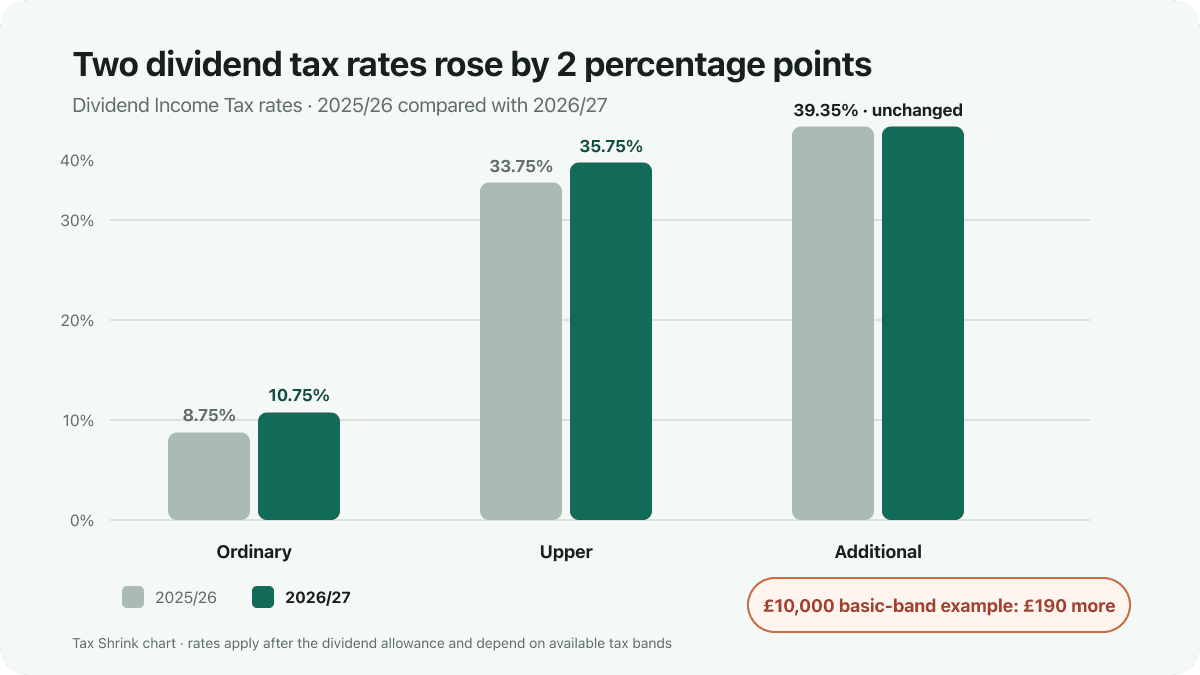
From 6 April 2026, the ordinary dividend rate rose from 8.75% to 10.75% and the upper rate from 33.75% to 35.75%. The additional rate stayed at 39.35%, and the Dividend Allowance stayed at £500. The change applies UK-wide.
A £10,000 gross dividend can leave £9,500 charged at an affected rate after an otherwise available £500 allowance, making the increase £190. A £10,000 amount already chargeable at the ordinary or upper rate increases by £200. See why £10,000 can mean a £190 or £200 dividend-tax increase, including the allowance and band assumptions behind both correct answers.
HMRC's technical note on dividend income (opens in new tab) confirms the enacted rates, the unchanged allowance and their UK-wide scope.
National Insurance: the 2025/26 structure carried over
Employer National Insurance remained 15% above the £5,000 Secondary Threshold. The main employee rate remained 8% above the £12,570 Primary Threshold up to the £50,270 Upper Earnings Limit, then 2% above it.
For a £12,570 annual salary, the supported no-Employment-Allowance scenario therefore still produces £1,135.50 of employer National Insurance: (£12,570 − £5,000) × 15%. Employee National Insurance at that salary is zero. Eligibility for Employment Allowance or a different National Insurance category can change the company-side result and sits outside this simple example.
Corporation Tax: 19%, marginal relief and 25% remained
The small-profits rate stayed at 19% for qualifying profits up to £50,000, while the main rate stayed at 25% above £250,000. Marginal relief continued between those limits. The limits are reduced for short accounting periods and associated companies, which is why the calculator states its 12-month, no-associated-companies baseline.
Salary and employer National Insurance can reduce company profit before Corporation Tax; dividends are paid from the remaining distributable post-tax profit. A higher personal dividend rate therefore cannot be compared with salary in isolation.
Scottish salary bands widened, but dividend rules did not
England, Wales or Northern Ireland kept the previous year's salary Income Tax bands. Scotland widened its 19% Starter band to £16,537 of gross salary and its 20% Basic band to £29,526 for someone receiving the full Personal Allowance. Its 21% Intermediate band still ended at £43,662; the Higher, Advanced and Top rates and thresholds did not change.
For salary only, the standard allowance and no other income:
| Salary | England, Wales or Northern Ireland | Scotland | Difference |
|---|---|---|---|
| £20,000 | £1,486.00 | £1,446.33 | Scotland £39.67 lower |
| £50,000 | £7,486.00 | £8,982.05 | Scotland £1,496.05 higher |
At £20,000, the widened lower Scottish bands make the bill slightly lower. At £50,000, salary has entered Scotland's 42% Higher band while it remains in the 20% band elsewhere. Open the £50,000 Scottish comparison and switch region to reproduce the difference. Scottish status follows the taxpayer, not the company; uncertain cases should use HMRC's residence guidance (opens in new tab).
Dividend income still uses UK-wide rates. Region nevertheless matters to a mixed-income calculation because Scottish salary tax changes the personal bill and salary occupies income-tax bands before dividends.
What the combined changes mean for an extraction plan
The higher dividend rates narrowed the advantage of some dividend-heavy combinations, but did not make salary the winner at every profit level. Extra salary can create National Insurance while reducing both Corporation Tax and the amount left for dividends; Scottish salary bands can alter the balance again.
If a plan used 2025/26 rates, rerun the same expected profit in the 2026/27 optimiser and compare the full take-home result. The tax-rate page shows the configured values. The methodology identifies cases—such as Employment Allowance, associated companies or other personal income—that require separate treatment.
Official sources
- HMRC: Income Tax rates and allowances, current and previous years (opens in new tab)
- HMRC: 2026/27 employer rates and thresholds (opens in new tab)
- HMRC: 2026/27 dividend-rate technical note (opens in new tab)
- HMRC: Corporation Tax rates (opens in new tab)
- Scottish Government: Scottish Income Tax 2026/27 (opens in new tab)
- Scottish Parliament: 2026/27 Scottish Rate Resolution (opens in new tab)
Continue the series
Previous: UK director tax changes in 2025/26. For the detailed dividend calculation, see why £10,000 can mean £190 or £200. You can also return to the full tax-year retrospective series.