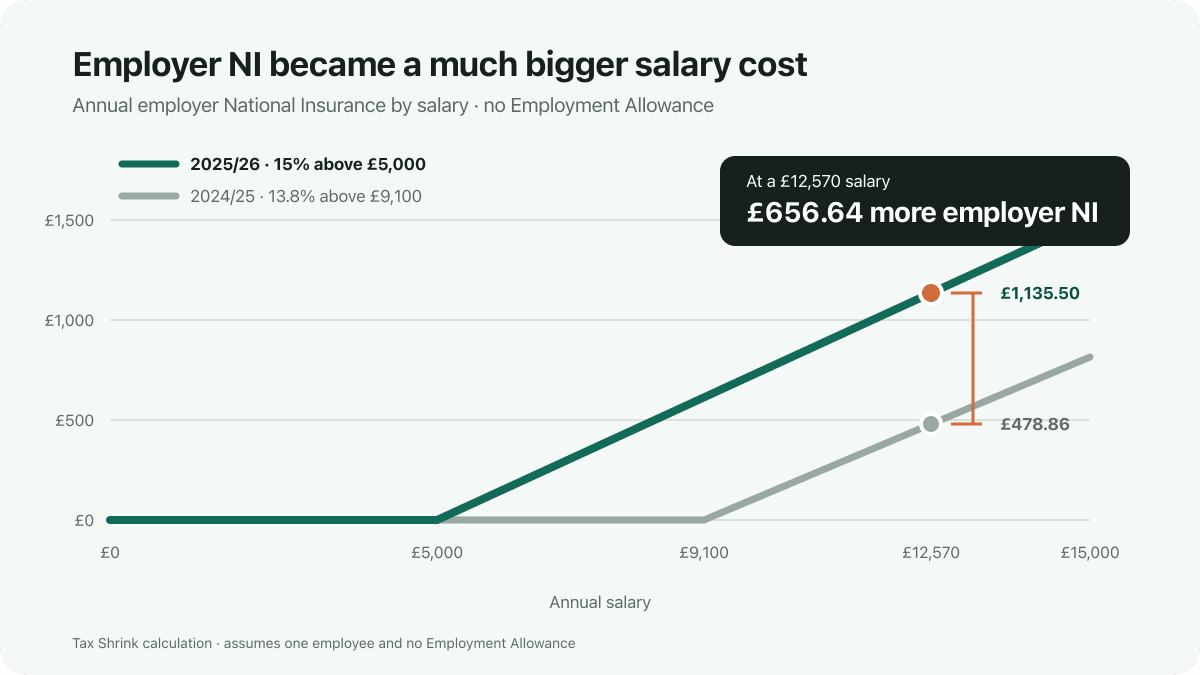
The employer NI change increased the company's cost before the director received anything. That made familiar salary rules of thumb less dependable even though employee NI and dividend rates did not rise.
The figures cover 6 April 2025 to 5 April 2026. They assume one shareholder-director who is the company's only employee, a 12-month accounting period, no associated companies and income taken through salary and dividends.
The £656.64 increase, step by step
The rate increase received most of the headlines, but the lower threshold mattered just as much for modest director salaries. From 6 April 2025, employer National Insurance was charged at 15% on ordinary Category A earnings above £5,000.
Assuming no Employment Allowance:
| Tax year | Employer NI calculation | Employer NI |
|---|---|---|
| 2024/25 | (£12,570 − £9,100) × 13.8% |
£478.86 |
| 2025/26 | (£12,570 − £5,000) × 15% |
£1,135.50 |
The company's employer NI cost rose by £656.64 for the same annual salary. Employee National Insurance remained zero at £12,570 because the employee Primary Threshold was still £12,570.
At £5,000, this company paid no employer NI. At £12,570, it paid £1,135.50 while putting another £7,570 through payroll; that extra salary would normally reduce taxable company profit. Those two salaries are useful comparison points, but the better result can only be found by calculating the Corporation Tax, dividend and personal-tax consequences together.
The focused 2025/26 employer NI and director-salary guide adds a £6,500 comparison and explains why the larger Employment Allowance often did not help a sole-director company.
The official change is set out in the Autumn Budget 2024 rates annex (opens in new tab) and HMRC's 2025/26 employer rate tables (opens in new tab).
Why the larger Employment Allowance often did not help a one-person company
The Employment Allowance increased from £5,000 to £10,500. The previous restriction for employers with more than £100,000 of secondary Class 1 liability was also removed. Eligible employers could offset more of their bill, but the typical one-person company described here received nothing from the increase.
HMRC excludes a company with just one director when that director is its only employee liable for secondary Class 1 National Insurance. Tax Shrink therefore assumes no Employment Allowance for its primary single-director scenario.
If the company has another employee or multiple directors, its position may be different. Check HMRC's single-director guidance (opens in new tab) before using the no-allowance comparison.
Other main rates did not mask the employer NI change
For 2025/26, the dividend allowance and dividend rates did not change. Corporation Tax also retained its 19% small profits rate, 25% main rate and marginal relief. For a 12-month company with no associated companies, employer NI was therefore the main new variable in the salary-and-dividend calculation.
Short accounting periods and associated companies can reduce the standard Corporation Tax limits. They need a separate calculation rather than the straightforward comparison used here.
Scotland slightly reduced the bill at £50,000
Salary Income Tax bands were unchanged in England, Wales or Northern Ireland. Scotland retained its six rates but widened the Starter and Basic bands, leaving slightly more salary taxed at 19% and 20% before the Intermediate band.
With the standard allowance and no other income, the Income Tax bill was approximately:
- £7,486.00 in England, Wales or Northern Ireland;
- £9,013.80 in Scotland.
The Scottish bill was £14.51 lower than in 2024/25 because of the wider lower bands, even though the Higher, Advanced and Top rates did not fall. Dividends remained on the UK-wide dividend schedule in both regions.
The Scottish reduction was modest beside the £656.64 employer NI increase, and employer NI itself was UK-wide. Open the £50,000 Scottish salary example and switch region to reproduce the comparison. Scottish status follows the individual, not the company's registered office.
Compare the whole company-and-director result
The tempting shortcut was to stop salary at the new £5,000 employer threshold. That avoided employer NI but ignored the Corporation Tax deduction and the personal consequences of taking the remaining profit as dividends.
Start by comparing £5,000 and £12,570 in the 2025/26 salary-and-dividend calculator, using the company's expected profit and the director's region. Then inspect the optimiser's result rather than treating either threshold as a default. The tax-rate page shows the figures used, and the methodology identifies cases that need separate advice.
Official sources
- HMRC: employer rates and thresholds for 2025/26 (opens in new tab)
- HM Treasury: Autumn Budget 2024 rates and allowances (opens in new tab)
- HMRC: Employment Allowance eligibility (opens in new tab)
- HMRC: Income Tax rates and allowances, current and previous years (opens in new tab)
- Scottish Government: Scottish Income Tax 2025/26 (opens in new tab)
- HMRC: Corporation Tax rates (opens in new tab)
Continue the series
- Previous: UK director tax changes in 2024/25.
- Next: UK director tax changes in 2026/27, when the ordinary and upper dividend tax rates increased.