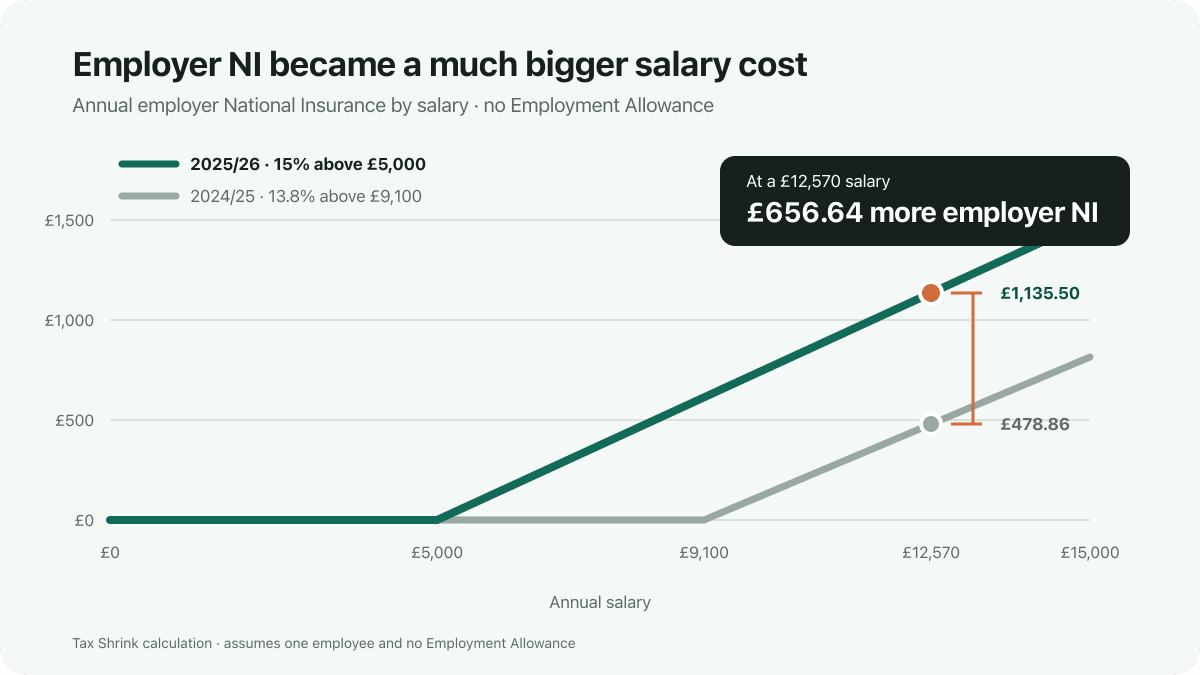
A £12,570 annual director salary created £1,135.50 of employer National Insurance in 2025/26 when Employment Allowance was unavailable. The same salary created £478.86 in 2024/25. The increase was £656.64 before allowing for the Corporation Tax deduction on the extra company cost.
That is the number a sole owner-director needed to understand after Autumn Budget 2024. The familiar argument for paying a salary up to the Personal Allowance did not disappear, but the company cost changed sharply. Repeating last year's salary without rerunning the combined calculation became harder to justify.
Two changes landed together
From 6 April 2025, the employer National Insurance rate increased from 13.8% to 15%. The annual Secondary Threshold also fell from £9,100 to £5,000. Employer NI therefore started sooner and accumulated at a higher rate.
The arithmetic at a £12,570 salary is straightforward:
| Tax year | Salary above Secondary Threshold | Employer NI calculation | Employer NI |
|---|---|---|---|
| 2024/25 | £12,570 − £9,100 = £3,470 | £3,470 × 13.8% | £478.86 |
| 2025/26 | £12,570 − £5,000 = £7,570 | £7,570 × 15% | £1,135.50 |
The threshold change accounts for much of the difference. Looking only at the 1.2 percentage-point rate rise misses the extra £4,100 of salary brought into the employer NI charge.
HMRC's published measure (opens in new tab) confirms both changes and their 6 April 2025 start date.
Three salary figures, three different company costs
The threshold makes a low salary comparison more useful than a single headline figure.
| Annual salary | 2024/25 employer NI | 2025/26 employer NI | Increase |
|---|---|---|---|
| £5,000 | £0 | £0 | £0 |
| £6,500 | £0 | £225 | £225 |
| £12,570 | £478.86 | £1,135.50 | £656.64 |
These are employer NI figures, not the final cost of choosing each salary. Salary and employer NI are normally deductible when calculating taxable company profit, so they can reduce Corporation Tax. Salary can also use the director's Personal Allowance and may protect National Insurance contribution records. Dividends come from post-Corporation-Tax profit and then enter the personal dividend-tax calculation.
The useful question is therefore not “How do I avoid employer NI?” It is “Which affordable salary and dividend combination leaves the highest estimated take-home after all modelled company and personal taxes?”
Tax Shrink's salary and dividend calculator compares that combined result. Its scope is deliberately narrow: one full-year owner-director, a 12-month accounting period, no associated companies and no Employment Allowance. Read the methodology and full assumptions before treating the estimate as a payroll decision.
Why Employment Allowance changes the answer
Employment Allowance increased to £10,500 for 2025/26, but a typical sole-director company cannot assume it is available. HMRC says a limited company cannot claim if it has only one director and that director is the only employee liable for secondary Class 1 National Insurance.
An additional employee can change eligibility, but the details matter. The other employee or director must be paid above the relevant Secondary Threshold, and connected-company rules can restrict which payroll receives the allowance. HMRC's single-director guidance (opens in new tab) sets out the tests and examples.
This is why an article saying “pay £12,570 because Employment Allowance covers the NI” can be wrong for Tax Shrink's primary reader. A sole director with no other employee above the threshold is precisely the case in which the allowance usually fails.
If the company has another employee, several directors or connected companies, the Tax Shrink comparison is no longer the right model. Ask the payroll provider or accountant to establish eligibility before comparing salary figures.
Scotland does not change employer NI
Employer National Insurance is UK-wide. The Scottish distinction enters through the director's Income Tax on salary, not through the company's employer NI rate.
That still changes the combined result. A Scottish taxpayer can reach higher salary-tax rates at different income levels, while dividends retain the UK-wide dividend schedule. Select the correct Income Tax region before comparing options and check the configured tax rates if a threshold is driving the result.
What to check before changing payroll
First confirm that the input is company profit after ordinary business costs but before director salary, employer NI and Corporation Tax. Turnover is not a substitute. Then establish whether Employment Allowance is genuinely available and whether the company has associated companies or an unusual accounting period.
Finally, compare the complete result at the company's expected profit. The £656.64 increase is real under the stated assumptions, but it is one part of the calculation. It does not by itself prove that a £12,570 salary became wrong, or that a £5,000 salary became right.
The broader 2025/26 owner-director retrospective places the employer NI change alongside the other rules for the year. For the next material extraction change, see what the 2026/27 dividend-tax rise costs.