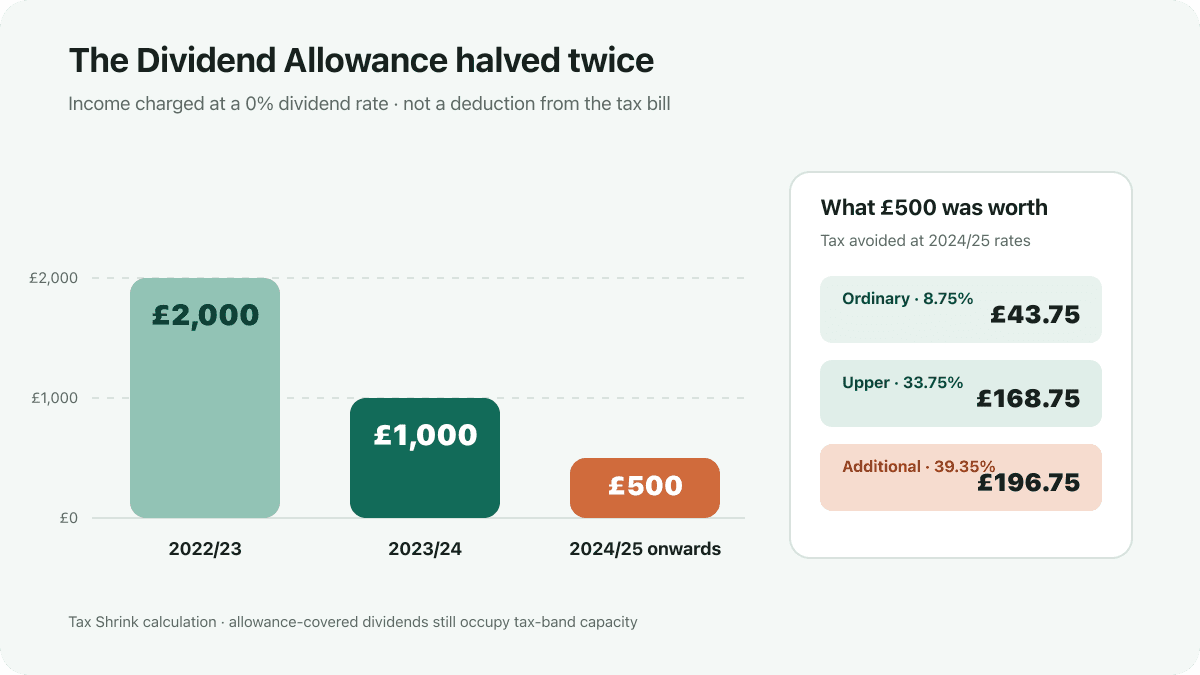
The Dividend Allowance fell to £500 on 6 April 2024. For a director whose next £500 of dividends would otherwise have been taxed at 8.75%, the allowance was worth £43.75. At 33.75%, it was worth £168.75. At 39.35%, it was worth £196.75.
None of those figures is £500. The allowance describes income charged at a 0% dividend rate, not an amount deducted from the final tax bill. That distinction explains both its actual value and one of the most common errors in informal dividend calculations.
The allowance halved twice
The annual amount moved quickly:
| Tax year | Dividend Allowance |
|---|---|
| 2022/23 | £2,000 |
| 2023/24 | £1,000 |
| 2024/25 onwards | £500 |
The move from £1,000 to £500 meant that an extra £500 of dividends became taxable from 2024/25, assuming the person received enough dividends to use the allowance in both years.
The additional tax on that £500 depended on the rate band:
| Rate applying to the extra £500 | Calculation | Additional tax |
|---|---|---|
| 8.75% ordinary rate | £500 × 8.75% | £43.75 |
| 33.75% upper rate | £500 × 33.75% | £168.75 |
| 39.35% additional rate | £500 × 39.35% | £196.75 |
These figures use the dividend rates in force for 2024/25. The ordinary and upper rates later increased from 6 April 2026, which changes the value of a £500 nil-rate amount for those bands. HMRC's Dividend Tax guidance (opens in new tab) records both the allowance history and the applicable rates.
It is a 0% rate, not an exemption from the bands
Dividends covered by the allowance are still part of total income. They are charged at 0%, but they use space in the rate band they occupy.
Suppose salary and other income leave exactly £1,000 of the basic-rate band available, and the director then receives £1,500 of dividends. The first £500 may be charged at 0% under the Dividend Allowance. Another £500 can use the remaining basic-rate capacity at the ordinary dividend rate. The final £500 then enters the upper dividend rate.
Removing the allowance-covered £500 from the calculation entirely would incorrectly leave all £1,000 of basic-rate capacity available for the later dividends. The immediate tax on the allowance slice is zero; its position in the income stack is not.
This is also why “My dividends are only £500, so they do not count” is unsafe language. They may produce no dividend tax, but they can still affect the treatment of income above them and can matter for adjusted net income calculations elsewhere in the tax system.
Salary and the Personal Allowance come before dividends
For the common owner-director scenario, salary is normally positioned before dividend income. Any available Personal Allowance is applied according to the tax rules, and the remaining taxable salary occupies non-savings bands before the dividends are considered.
A £500 Dividend Allowance therefore does not mean every director can take £13,070 tax-free by adding it to the £12,570 Personal Allowance. Whether salary or dividends use the Personal Allowance depends on the complete income calculation. The dividend allowance then applies at 0% within the dividend's own position.
The personal-tax calculator displays salary, dividend and detailed band charges across supported years. It is useful for seeing the ordering, but it does not include other employment income, pensions, property, savings, student loans or reliefs.
The allowance did not make a dividend legal
Tax treatment and company-law permission are separate questions. A company needs sufficient distributable profits before it can declare a dividend. The directors should document the decision and issue the appropriate dividend paperwork.
The £500 allowance does not authorise a distribution, convert salary into a dividend or cure an unlawful payment. It only affects the individual's dividend Income Tax calculation after a valid dividend exists.
Tax Shrink estimates the available dividend after modelled Corporation Tax for its supported scenario. It does not inspect the company's accounts, reserves, prior losses or interim financial information. Those records determine what the company can actually distribute.
Scotland uses the same Dividend Allowance
Dividend tax is UK-wide. The £500 allowance and dividend rates do not change because the taxpayer is Scottish.
Scottish status still matters when salary is present. Scotland's non-savings, non-dividend bands apply to salary, and salary is positioned before the UK-wide dividend calculation. The same dividend can therefore sit above a different salary-tax result, even though its own rate schedule is shared.
The tax-rate reference keeps the regional salary schedules separate from the common dividend schedule. This is more reliable than applying a Scottish salary rate to the entire salary-and-dividend total.
What the smaller allowance changed in practice
For many owner-directors, the direct cost of the 2024/25 reduction was tens or hundreds of pounds, not thousands. The more important lesson was structural: the tax-free-looking portion of a dividend had become small, and remembered figures from earlier years were increasingly unreliable.
The allowance is only one input. Corporation Tax determines the post-tax company profit available for dividends, and the director's salary, region and other income determine where those dividends land. Compare the complete annual position rather than increasing or reducing a dividend solely because the allowance moved.
From 2026/27, the allowance stayed at £500 while two dividend rates rose. The company-director dividend-tax guide shows the later £20 increase for each £1,000 taxed in the ordinary or upper band.
The 2024/25 owner-director retrospective places the £500 allowance alongside the year's National Insurance and Scottish Income Tax changes. The methodology explains exactly which parts Tax Shrink models.