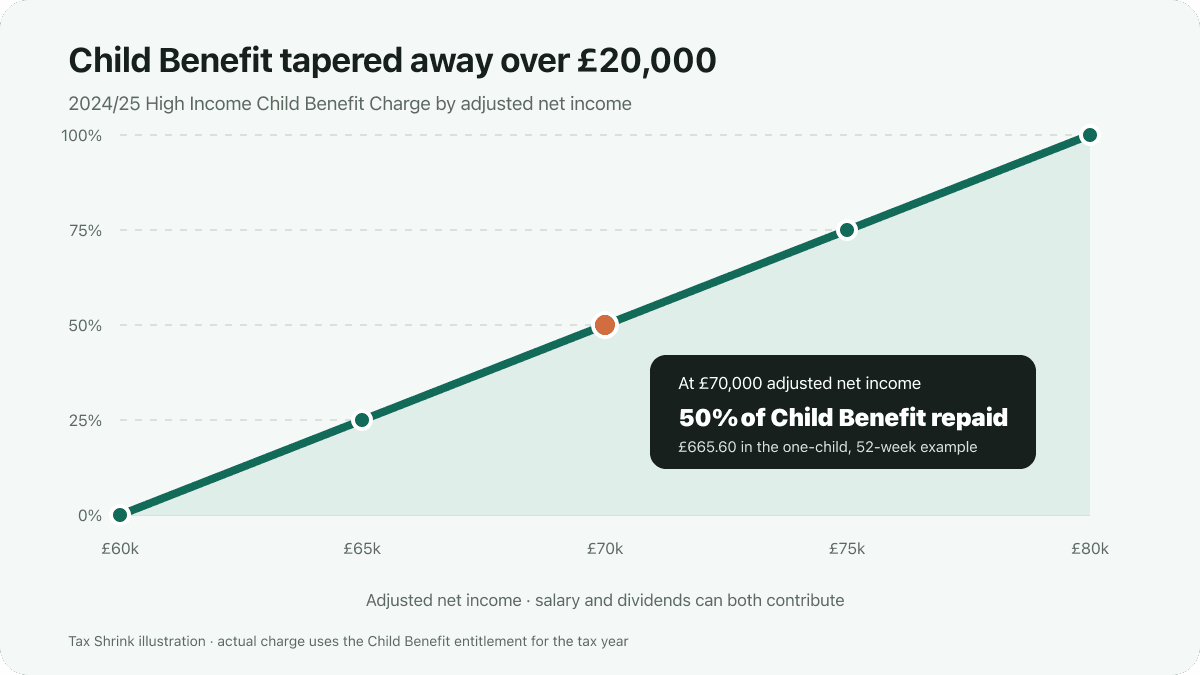
A parent with £70,000 of adjusted net income is halfway through the 2026/27 High Income Child Benefit Charge taper. If the household receives £1,406.60 for one child over 52 weeks, the illustrative charge is £703.30.
That household cost does not appear in an ordinary salary-and-dividend tax calculation. Salary and dividends can both push adjusted net income through the taper, so the combination with the highest estimated personal take-home before Child Benefit is not necessarily the combination that leaves the family with the most money.
A second, separate taper removes the Personal Allowance above £100,000 of adjusted net income. The two are different rules at different thresholds, and both respond to the same salary and dividend decision. See what the next pound above £100,000 costs.
The taper runs from £60,000 to £80,000
Since 6 April 2024, the charge has started when the higher-income partner's adjusted net income exceeds £60,000. It recovers 1% of the household's Child Benefit for every £200 above that threshold. At £80,000 or more, the charge equals the full Child Benefit received. The thresholds are unchanged in 2026/27.
| Adjusted net income | Percentage of Child Benefit charged |
|---|---|
| £60,000 or less | 0% |
| £65,000 | 25% |
| £70,000 | 50% |
| £75,000 | 75% |
| £80,000 or more | 100% |
Before 2024/25, the taper ran from £50,000 to £60,000 at 1% for every £100. The Spring Budget change raised the starting point and spread the withdrawal over £20,000. HMRC's policy paper (opens in new tab) confirms the £60,000 threshold and 1%-per-£200 calculation.
Reproducing the one-child example
The weekly Child Benefit rate for an eldest or only child is £27.05 in 2026/27, and £17.90 for each additional child. A simple 52-week illustration gives:
£27.05 × 52 = £1,406.60 Child Benefit
At £70,000 adjusted net income, the excess over the threshold is £10,000:
(£70,000 − £60,000) ÷ £200 = 50
The charge is therefore 50% of the benefit:
£1,406.60 × 50% = £703.30
The actual charge uses the Child Benefit entitlement received for the relevant tax year, so payment weeks, additional children and changes during the year can alter the amount. This example isolates the taper rather than reproducing a family's return.
Dividends count even when the allowance covers them
Adjusted net income starts from taxable income and then applies specified adjustments. Salary, dividends, savings and other taxable income can all be relevant. The fact that some dividend income is charged at 0% under the Dividend Allowance does not make it disappear from adjusted net income.
The £500 Dividend Allowance guide explains that 0% treatment and the separate question of where dividends sit in the Income Tax bands.
This can surprise a director who keeps salary near the Personal Allowance and takes the rest as dividends. The salary may look modest, but the combined personal income can pass £60,000.
For example, £12,570 of salary and £57,430 of dividends total £70,000 before considering any other income or adjustments. The £500 Dividend Allowance changes the dividend tax calculation, not the headline £70,000 starting point for this illustration.
Use the personal-tax calculator to understand the modelled Income Tax and National Insurance. Then calculate the Child Benefit position separately. Tax Shrink does not ask whether the user or a partner claims Child Benefit and does not add this charge to its results.
Pension contributions and Gift Aid can change adjusted net income
HMRC's adjusted net income guidance (opens in new tab) explains the deductions that can apply, including certain gross pension contributions and Gift Aid donations. The mechanism depends on how the contribution or donation is made.
This does not mean that spending £1 on a pension contribution automatically produces £1 of free household income. The contribution moves money into a pension, access is restricted, annual-allowance rules can apply and the tax treatment depends on the arrangement. Gift Aid is a genuine donation, not a device for recovering more Child Benefit than the donation costs.
Treat these as parts of wider financial planning. If a contribution was already intended, its effect on adjusted net income is worth including. Do not create one solely from a simplified taper example without checking affordability and the applicable rules.
The charge looks at partners asymmetrically
The charge generally falls on the partner with the higher adjusted net income when either partner receives Child Benefit. Household income is not simply added together for the threshold test.
That can produce different outcomes for families with the same combined income. Two partners at £55,000 each can sit below the individual threshold, while one partner at £70,000 and the other at £40,000 can trigger a 50% charge, assuming the same Child Benefit entitlement and no adjustments.
The identity of the claimant also matters for National Insurance credits. A person can sometimes claim Child Benefit and opt out of receiving payments, preserving entitlement and credits without creating payments to repay. HMRC's Child Benefit guidance (opens in new tab) explains the options and filing responsibilities.
Why the tax-only optimum can be incomplete
Tax Shrink compares salary and dividends under a deliberately bounded model. It does not know about children, a partner's income, pension contributions, Gift Aid, student loans or means-tested support.
For a parent near £60,000–£80,000 adjusted net income, those omissions can be material. The calculator remains useful for understanding the company and personal taxes it does model, but its highlighted take-home result is not a household recommendation.
The practical sequence is:
- calculate the salary, dividends, company taxes and personal taxes;
- add other taxable income and adjusted-net-income deductions;
- calculate the family's Child Benefit charge; and
- compare the complete household outcomes before changing payroll or dividends.
The 2024/25 owner-director retrospective covers the year the threshold rose, and the 2026/27 retrospective covers the current salary and dividend rules. The methodology lists the exclusions that make this separate household check necessary.