Prime Minister Andy Burnham announced the proposals (opens in new tab) on 29 September 2026. They would change how the State Pension increases and use the savings to help fund a National Care Service.
What is the triple lock?
The triple lock is a government commitment to increase the basic State Pension and the full new State Pension each April. The increase normally follows whichever of these is highest.
- Average earnings growth
- Consumer Prices Index (CPI) inflation
- 2.5%
It was introduced in 2011 after decades in which the State Pension had fallen behind earnings. The guarantee is government policy, not a permanent legal entitlement. In April 2022, the earnings part was temporarily suspended.
Why economists call it a ‘ratchet effect’
Each increase becomes the starting point for the next. If prices rise faster than earnings, pensions follow prices. If earnings grow faster, pensions follow earnings. If both are below 2.5%, the minimum increase applies.
Over time, this can push pensions higher relative to earnings and make government spending less predictable. Earnings growth set the last three increases (opens in new tab). These were 8.5% in April 2024, 4.1% in April 2025 and 4.8% in April 2026.
What changes is Andy Burnham proposing?
The current triple lock would remain until April 2030. After that, pensions would rise each year by at least inflation or 2.5%, whichever is higher.
Additional increases would apply when needed to maintain the pension’s value relative to earnings (opens in new tab) over time. The earnings link would therefore change rather than disappear. A year of strong wage growth would not automatically produce the same percentage increase in pensions.
The savings would help fund a National Care Service. Government analysis (opens in new tab) estimates annual savings of around £15 billion in 2039/40, compared with keeping the current triple lock. That figure is in that year’s prices, not today’s money. It depends on assumptions about future inflation, earnings and other factors.
The Institute for Fiscal Studies warns (opens in new tab) that savings would initially be small and should not be expected to fund universal social care during the next Parliament. The government plans to introduce the service in stages.
What does this mean for business owners and sole traders?
Pension increases could be smaller
Under the proposal, pensions would continue to increase, but could grow more slowly than under the existing triple lock. This would mean smaller future increases, not a reduction in your current weekly pension. The proposed system would retain protection against inflation and a link to earnings over time.
Personal care costs could fall, but other costs would remain
The proposed service concerns personal care for older people in England, including help with washing and eating. It would not cover accommodation and food (opens in new tab) in care homes. Council support for those costs would still depend on your finances. That could reduce some costs in later life, but it would not remove the need to plan for care expenses.
The State Pension remains a starting point
In 2026/27, the full new State Pension is £241.30 a week (opens in new tab). That is approximately £12,548 a year before tax. Your own entitlement depends on your National Insurance record.
Whether that covers your needs depends on your housing costs, household circumstances and other income. Start with the retirement income you want, rather than assuming the State Pension will be enough.
Action checklist for business owners
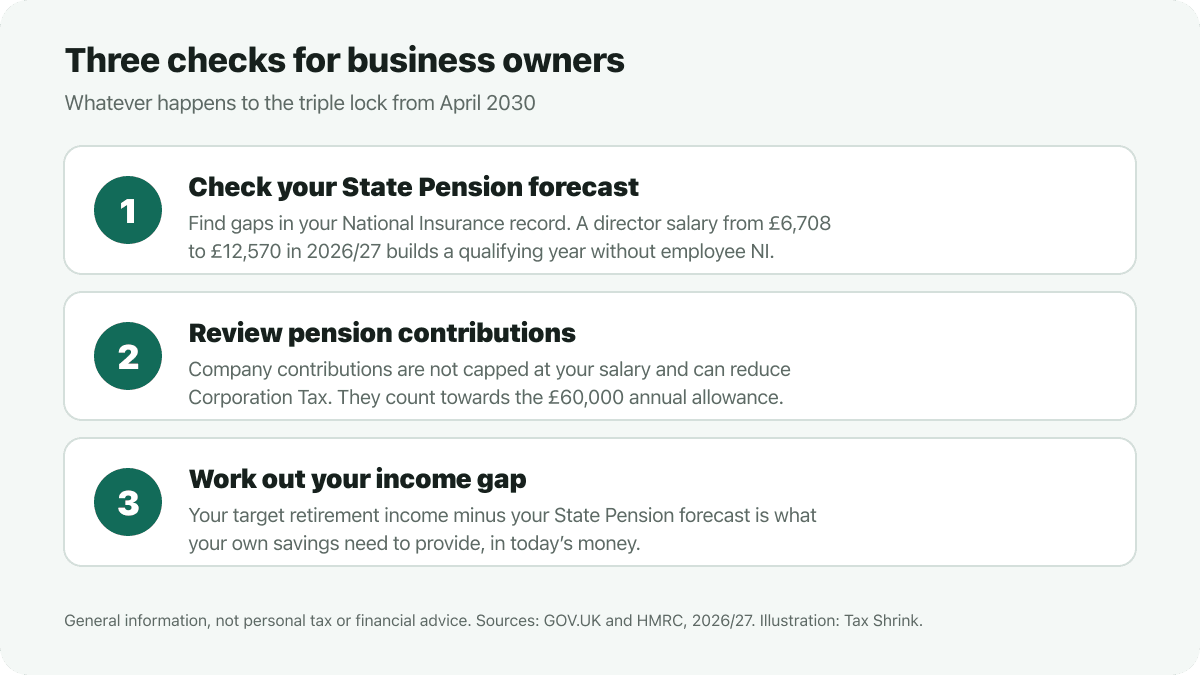
1. Check your State Pension forecast and National Insurance record
Use the State Pension forecast service (opens in new tab) to see how much you could receive and whether you can increase it.
You normally need at least 10 qualifying years for any new State Pension. However, 35 years does not always guarantee the full amount. Records from before April 2016 can involve different calculations. Your personal forecast is more useful than a general rule.
For company directors, an annual salary from £6,708 to £12,570 in 2026/27 can build up an NI record without employee NI payments. However, employer NI normally starts above £5,000, so your company may still have a bill. No employee NI does not mean no NI cost. See our 2026/27 director salary and dividend guide for the wider calculation.
For sole traders with profits of at least £7,105 in 2026/27, Class 2 contributions are generally treated as paid without any payment being required. Below that, voluntary Class 2 contributions cost £3.65 a week. Check whether paying would improve your pension before doing so.
2. Consider pension contributions alongside salary and dividends
Company directors can arrange for their limited company to pay employer contributions directly into a registered pension, such as a SIPP (Self Invested Personal Pension). These can reduce Corporation Tax, provided they meet HMRC’s rules for business expenses. The contributions must actually be paid to qualify for relief.
Employer pension contributions are not capped at your salary. This matters for directors who take a small salary and the rest of their income as dividends. Personal pension contributions have different rules for tax relief.
Under current rules, an employer contribution normally attracts neither personal Income Tax nor employee or employer NI. However, it counts towards your pension annual allowance.
The standard annual allowance is £60,000 in 2026/27, across your pensions and including employer contributions. Lower allowances can apply to high earners and people who have flexibly accessed their pensions. Unused allowance from the previous three tax years may also be available.
Sole traders can make personal pension contributions and receive Income Tax relief, subject to the applicable limits.
Pension money is normally locked away until at least age 55, rising to 57 from 6 April 2028. Withdrawals are generally taxable apart from the amounts you can take free of tax. Keep enough accessible money for business and personal needs.
Tax Shrink’s calculators do not currently model pension contributions. See our methodology for what the calculations include.
3. Work out your retirement income gap
Compare your target annual retirement income with your State Pension forecast and other expected retirement income. Use today’s money throughout and allow for tax.
The difference is your annual income shortfall, not the exact pension pot you need. Estimating that pot also means considering investment growth, charges, when you retire and how long the money needs to last.
The proposed reform does not change the starting point. Check your forecast, review your contributions and work out how much more you need to save.
This article provides general information and not personal tax or financial advice.
Primary sources
Policy and State Pension
Government announcement of the pension and care proposals (opens in new tab) and DWP analysis of the proposed changes and estimated savings (opens in new tab).
House of Commons Library history of the triple lock (opens in new tab) and Government Actuary’s report on the 2026 pension increases (opens in new tab).
GOV.UK State Pension rates and qualifying years (opens in new tab) and eligibility rules (opens in new tab). These explain the usual 10 year minimum and why the years needed for a full pension can vary.
National Insurance
HMRC employer rates and thresholds for 2026/27 (opens in new tab) and National Insurance rules for sole traders (opens in new tab). These provide the salary thresholds, profit threshold and voluntary Class 2 rate used above.
Pension contributions and withdrawals
HMRC pension contribution principles (opens in new tab), company tax relief rules (opens in new tab) and the Income Tax and NI treatment of employer contributions (opens in new tab). These distinguish employer contributions from personal contributions and explain the conditions for relief.
GOV.UK annual allowance guidance (opens in new tab), HMRC pension access age rules (opens in new tab) and tax on pension withdrawals (opens in new tab). These cover contribution allowances, access restrictions and withdrawal tax.
Independent analysis
IFS assessment of the proposed pension changes and social care funding (opens in new tab) and the Health Foundation’s response on social care in England (opens in new tab).