The split changes because each extra pound of salary affects the company and the director at the same time. Salary reduces company profit, but it can create employer and employee National Insurance as well as personal Income Tax. A dividend is paid from profit left after Corporation Tax, then enters the director's personal tax calculation.
That chain has thresholds rather than one smooth rate. A fixed salary or percentage can be close at one profit level and wide of the highest tested result at another.
Four comparisons show where the pattern breaks
These examples use Tax Shrink's narrow owner-director scenario: one director and shareholder, a 12-month accounting period, no associated companies, no Employment Allowance and no other personal income. The input is company profit after ordinary business costs but before director salary, employer National Insurance and Corporation Tax. All available post-tax profit is distributed.
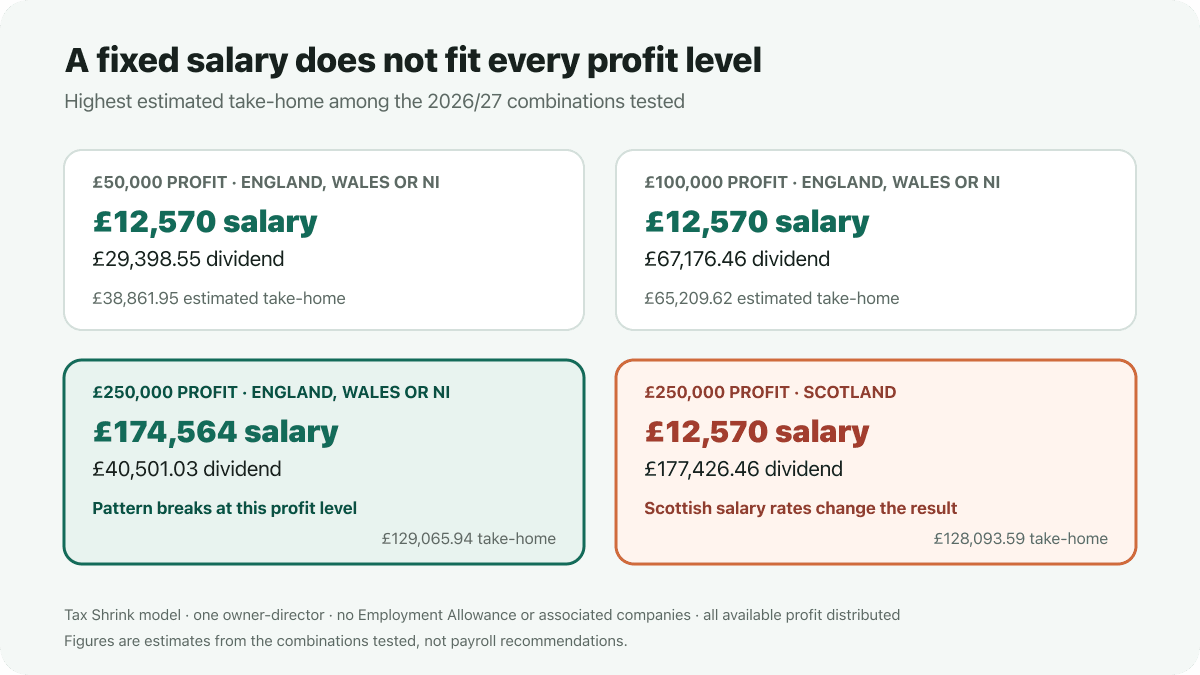
| Company profit before director pay | Income Tax region | Salary in highest-tested result | Available dividend | Estimated take-home |
|---|---|---|---|---|
| £50,000 | England, Wales or Northern Ireland | £12,570 | £29,398.55 | £38,861.95 |
| £100,000 | England, Wales or Northern Ireland | £12,570 | £67,176.46 | £65,209.62 |
| £250,000 | England, Wales or Northern Ireland | £174,564 | £40,501.03 | £129,065.94 |
| £250,000 | Scotland | £12,570 | £177,426.46 | £128,093.59 |
These are the highest estimated take-home figures among the annual salary and dividend combinations tested. They are not payroll instructions. Open the £50,000, £100,000 or £250,000 comparison to inspect the company taxes and personal deductions behind each figure.
Why £12,570 appears at £50,000 and £100,000
The standard Personal Allowance and employee National Insurance Primary Threshold were both £12,570 in 2026/27. A salary at that level used the allowance and did not create employee NI in this annual model. The company still paid employer NI: the rate was 15% above the £5,000 Secondary Threshold, producing £1,135.50 on a £12,570 salary when Employment Allowance was unavailable.
That employer cost does not settle the choice. Salary and employer NI reduce taxable company profit, while dividends do not. Corporation Tax was 19% at or below £50,000 of profit and 25% above £250,000, with marginal relief between those limits for a 12-month company with no associated companies. Dividend tax then applied after the £500 Dividend Allowance at 10.75%, 35.75% or 39.35%, depending on the bands already occupied by salary and other income.
At both lower profit examples, the balance of those rules left £12,570 as the highest salary tested. This does not make it a standing annual instruction. Tax Shrink can include other employment or pension income and the Employment Allowance still available to an eligible company. Those inputs can change the result; irregular accounting periods remain outside the model.
If you also have a job, start with the director salary with other employment income guide or open £40,000 of company profit alongside a £30,000 job. That example distributes all current profit, with no prior-year reserves, other dividends or Employment Allowance. The other job occupies allowances and tax bands; its pay is excluded from the company's take-home estimate.
At £250,000, the Income Tax region changes the answer
The England, Wales or Northern Ireland comparison reaches a very different result at £250,000 of profit. A £174,564 salary was the highest-tested point, with £40,501.03 left as an available dividend. By then, the alternative dividend-heavy route exposes more income to the 39.35% additional dividend rate, while salary reduces the company's Corporation Tax base. The interaction is unusual enough that copying the lower-profit salary would miss it.
Scotland changes the salary side of the calculation. Its 2026/27 non-savings, non-dividend rates reached 45% in the Advanced band and 48% in the Top band. Dividends, Corporation Tax and National Insurance remained UK-wide. Under the same £250,000 company assumptions, £12,570 was therefore the highest salary tested for a Scottish taxpayer, not £174,564. Open the £250,000 Scottish comparison to inspect that result, or read how the Personal Allowance taper changes the tax on personal income.
The company location does not decide which row applies. Scottish Income Tax status follows the taxpayer. If your status is uncertain because of a move, more than one home or another residency complication, use HMRC's Scottish taxpayer guidance (opens in new tab) rather than treating the site-wide region switch as a determination.
Check the inputs before comparing the outputs
Four checks matter more than copying a headline figure:
- Start with profit, not turnover. Deduct ordinary business costs first, but leave director salary, employer NI and Corporation Tax in the amount entered.
- Choose the director's Income Tax region. Scotland changes tax on salary, while dividends remain on the UK-wide schedule.
- Enter supported optional inputs and check the omissions. Add other employment or pension income, outside dividends and any Employment Allowance still available to your eligible company. Pension contributions, benefits, student loans, associated companies and irregular accounting periods remain outside the model.
- Confirm that a dividend can legally be paid. A company cannot pay more in dividends than its available profits from current and previous financial years, and it must keep the required records.
Tax Shrink compares the arithmetic it supports. Your accountant still needs to consider payroll timing, dividend records, cash needs, National Insurance contribution history and facts the calculator does not collect. The full boundary is set out in the methodology, while the 2026/27 tax-rate reference shows the configured rates and worked tax examples.
Still deciding on your business structure? The sole trader versus limited company comparison starts both sides with the same taxable profit and no other income. It excludes accountancy-fee differences and formation costs, so use it to explore the tax arithmetic before considering the wider decision.
Primary sources
- HMRC: Income Tax rates and allowances (opens in new tab)
- HMRC: employer rates and thresholds for 2026/27 (opens in new tab)
- HMRC: Corporation Tax rates and allowances (opens in new tab)
- Scottish Government: Scottish Income Tax rates and bands for 2026/27 (opens in new tab)
- GOV.UK: taking money out of a limited company (opens in new tab)
The 2026/27 director tax retrospective explains what changed during the year. The 2026/27 dividend-tax guide looks more closely at the rate rise behind the dividend-heavy comparisons.