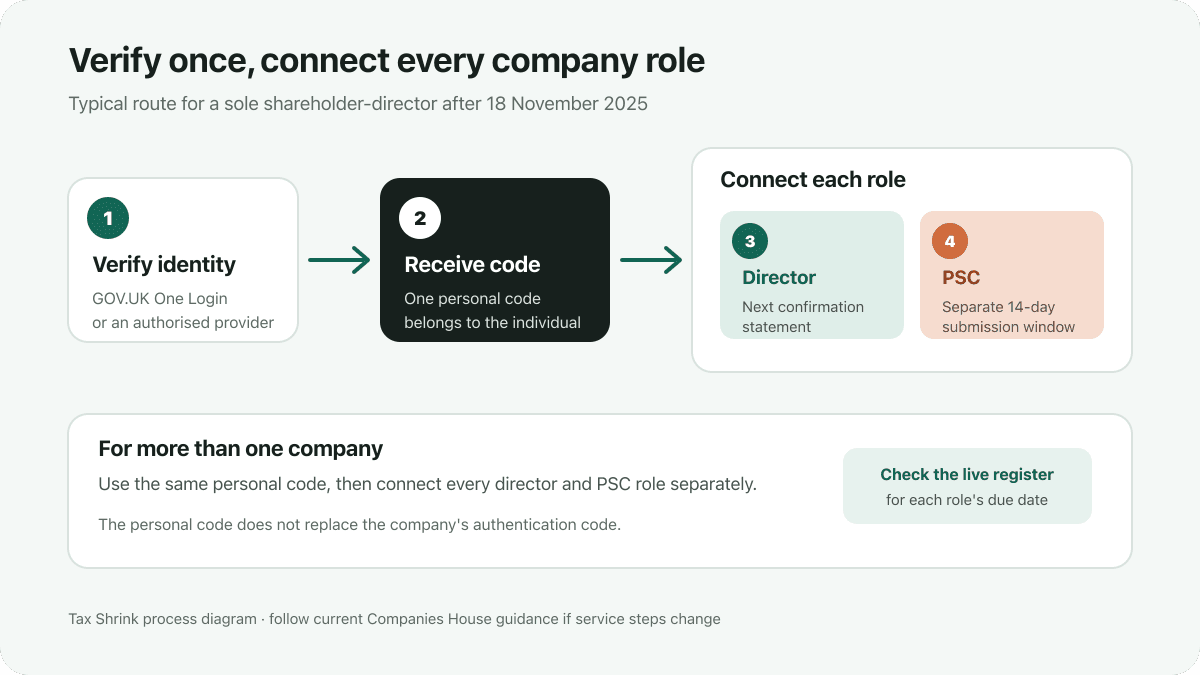
A sole shareholder-director usually appears on the Companies House register in two capacities: director and person with significant control, or PSC. Identity verification normally happens once, but the resulting personal code must be used to connect that verified identity to each relevant role.
The practical risk is not a difficult identity check. It is assuming that receiving a personal code finished the job. For an existing company, the director connection and PSC connection can follow different filing steps even when the same person holds both roles.
The requirement began on 18 November 2025
Companies House made identity verification compulsory from 18 November 2025. From that date:
- a new director had to verify before incorporating a company or being appointed;
- an existing director had to provide their personal code through the company's next confirmation statement during the transition period; and
- a PSC had to provide verification details during the 14-day period allocated to that PSC role.
Companies House announced the final timetable on 5 August 2025 and encouraged people to verify before their deadline. Its rollout announcement (opens in new tab) estimated that six to seven million people would need to complete the process by mid-November 2026.
The live identity-verification guidance (opens in new tab) should take precedence over an older article if Companies House changes a service step or extends a transition arrangement.
A four-step route for a typical sole director
1. Verify the individual
The individual can usually verify through GOV.UK One Login. An Authorised Corporate Service Provider, such as a suitably registered accountant or company-formation agent, can also perform verification.
Companies House asks for information about the person, not the company. The available evidence and route can vary, so follow the live service rather than preparing documents from an unofficial checklist.
2. Receive the personal code
Successful verification produces a Companies House personal code. The code belongs to the individual, not to one company. The same person uses it for each company role that must be connected.
Treat the code as personal administrative information. It may need to be supplied to an accountant or other person authorised to make a filing, but it should not be published in minutes, invoices, email signatures or other public material.
3. Connect the director role
An existing director provides the code as part of the company's next confirmation statement process. Companies House says a company will be unable to file its confirmation statement unless all directors who need verification have supplied the required codes.
For a newly appointed director, verification and the code form part of the appointment or incorporation process. Acting as a director without complying after the applicable deadline can be an offence.
4. Connect the PSC role
A PSC has a separate legal role on the register. Companies House provides a service for submitting the personal code and verification statement for that PSC position.
For a person who was already both a director and PSC when the mandatory regime began, the PSC's 14-day period is linked to the company's confirmation-statement date. Other PSC situations use different appointed periods. Check the date shown on the register rather than assuming that every PSC deadline matches the annual filing deadline.
One person, several companies
The identity check is personal, so a director of three companies should not create three verified identities. The one personal code is connected to the director role in each company and to every PSC role the person holds.
That makes a simple role inventory useful:
| Company | Director role connected? | PSC role connected? | Confirmation statement due |
|---|---|---|---|
| Company A | Check | Check if applicable | Record date |
| Company B | Check | Check if applicable | Record date |
This is an administrative checklist, not a place to copy identity documents or the personal code. Keep only the status and deadline in an ordinary company compliance calendar; store any sensitive information through an appropriately protected route.
Verification does not replace the authentication code
The Companies House personal code identifies a verified person. A company authentication code authorises online filings for the company. They serve different purposes.
Do not discard the company authentication code after personal verification, and do not assume that possession of an authentication code proves a director's identity. Existing filing software and accountants may need both pieces of information for different stages of the process.
The confirmation-statement service (opens in new tab) explains the current filing requirements and fee. Check it close to the filing date because Companies House services and prices can change.
What if the accountant handles Companies House filings?
Ask who is responsible for each step. An accountant may be an Authorised Corporate Service Provider and may be able to verify a client, but that does not happen merely because the accountant files the company's accounts or confirmation statement.
A useful exchange is specific:
- Has my identity been verified?
- Who holds the personal code?
- Has the director role been connected?
- Does the PSC role require a separate submission, and what is its deadline?
Avoid sending passports or driving-licence images by ordinary email unless the provider has explicitly established a suitable process. Tax Shrink does not need or collect identity documents, personal codes or Companies House authentication codes.
Why this belongs in an owner-director tax blog
Identity verification does not change salary, dividends or Corporation Tax. It does change the minimum administration required to keep a company compliant, and missed filings can obstruct the same company through which the director takes income.
The distinction matters editorially. Tax Shrink's calculators model a narrow remuneration scenario; they do not monitor statutory filings. The methodology explains the calculation boundary, while this guide covers one external obligation that almost every limited company director must handle.
Verify through an official route, record each role and confirm the deadline shown by Companies House. That is enough for most straightforward companies. Complex ownership, overseas evidence, corporate officers or disputed register entries need more specific guidance.