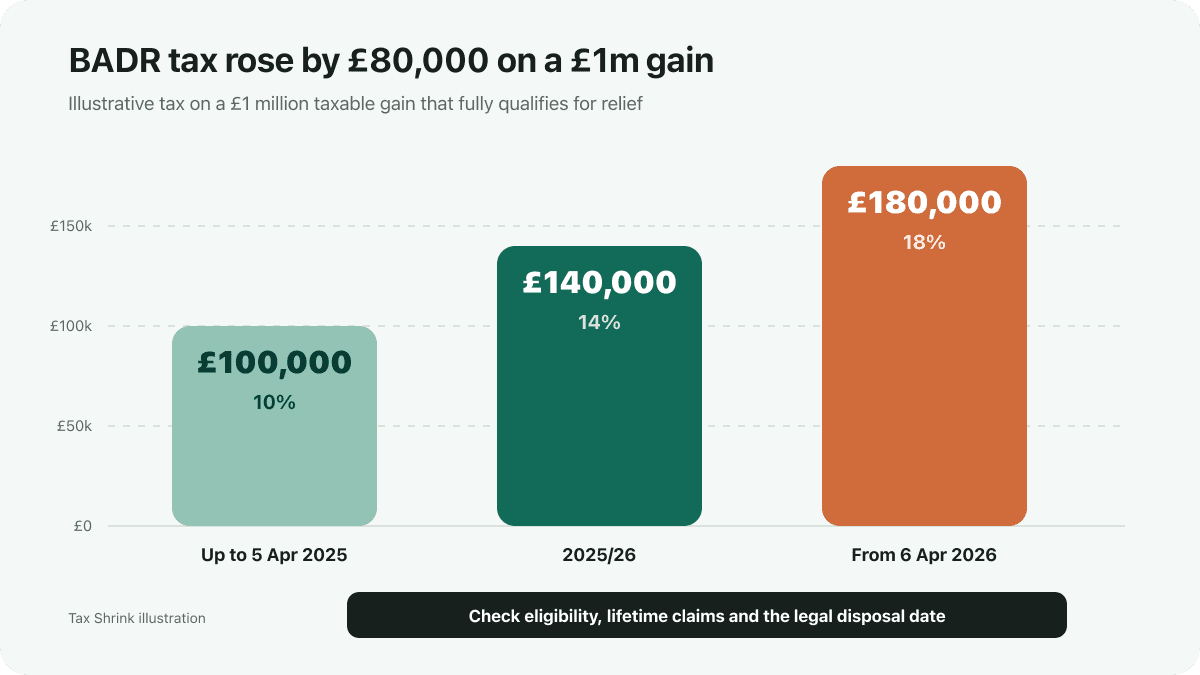
Tax on a £1 million taxable gain qualifying for Business Asset Disposal Relief was £100,000 at 10%. The same taxable gain produces £140,000 at 14% and £180,000 at 18%. The gap between the old and current rates is £80,000.
That comparison explains why the Autumn Budget 2024 announcement mattered to an owner considering a sale or winding-up. It does not establish that the relief applies, that the gain is exactly £1 million or that accelerating a transaction is sensible. Those questions depend on the company, shares, buyer, documentation and the date the disposal legally occurs.
The increase was deliberately phased
The Business Asset Disposal Relief rate changed as follows:
| Disposal date | BADR rate | Tax on a £1 million taxable qualifying gain |
|---|---|---|
| On or before 5 April 2025 | 10% | £100,000 |
| 6 April 2025–5 April 2026 | 14% | £140,000 |
| From 6 April 2026 | 18% | £180,000 |
The example assumes the entire £1 million is a taxable gain that qualifies for relief after allowable costs, losses and any available annual exempt amount have already been considered. It also assumes no earlier BADR claims have used part of the £1 million lifetime limit.
HMRC's Capital Gains Tax measure (opens in new tab) confirms the phased rates. The current BADR guidance (opens in new tab) should be checked for eligibility and claim deadlines.
A company sale and an asset sale are not the same
An owner selling shares calculates a personal capital gain on those shares. A company selling its trade or assets can first incur Corporation Tax inside the company, after which the owner still needs a lawful route to extract the remaining cash. The tax sequence can be very different.
Likewise, closing a solvent company and receiving a capital distribution is not automatically equivalent to selling shares to a buyer. Formal liquidation, distributions, continuing similar activities and anti-avoidance rules can all affect the treatment.
An article can illustrate the rate, but it cannot choose the transaction structure. Obtain advice before signing heads of terms, passing liquidation resolutions or moving assets. By the time cash is distributed, some decisions may be difficult to reverse.
The share conditions need evidence
For an ordinary share sale, HMRC's guidance requires conditions to be met for at least two years before disposal. In broad terms, the person must be an employee or office holder of the company, and the company must be a trading company or holding company of a trading group.
The personal-company tests usually require at least 5% of the ordinary share capital and voting rights, plus an economic entitlement test concerning profits, assets on a winding-up or sale proceeds. Share classes, options, preference rights, recent issues and reorganisations can make a percentage shown on a cap table insufficient evidence by itself.
The trading condition can also be less obvious than the company's label. Substantial investment activity, surplus property, long periods of dormancy or a change in trade before sale may need analysis. Keep share records, employment or office-holder evidence, accounts and transaction documents that support the claim.
The lifetime limit is not a yearly allowance
BADR applies to qualifying gains up to a £1 million lifetime limit per person. It does not reset each tax year. Earlier Entrepreneurs' Relief and BADR claims count towards the same history.
Where spouses or civil partners each own qualifying shares, each person is tested separately and has their own lifetime limit. Transferring shares shortly before a sale does not manufacture a two-year ownership and employment history. Any ownership planning needs to happen early enough to satisfy the actual conditions and for genuine commercial and family reasons.
For the £1 million illustration, a person who had already used £300,000 of lifetime limit would have at most £700,000 of remaining qualifying gains, assuming every other condition was met. The balance would face the applicable normal Capital Gains Tax treatment rather than the BADR rate.
Why the date of disposal cannot be guessed
Tax law determines when a disposal occurs. Contract dates, conditions and completion can interact, and the rate-rise legislation included provisions aimed at arrangements designed to secure an earlier rate artificially.
This makes “complete before 6 April” an unsafe instruction without reviewing the contract and anti-forestalling rules. A rushed sale can sacrifice value, warranties or due diligence for a tax assumption that does not hold.
The correct sequence is to model the transaction, confirm eligibility and establish the tax disposal date before relying on a rate. The £40,000 and £80,000 differences on a £1 million gain show why the work deserves attention; they do not replace it.
This sits outside Tax Shrink's calculator
Tax Shrink compares annual salary and dividends for a continuing, straightforward limited company. It does not calculate capital gains, BADR, liquidation distributions, share-sale proceeds or transaction costs.
Do not enter a proposed sale price as annual company profit and interpret the result as an exit calculation. The methodology describes the supported recurring-income model, and the tax-rate page covers its configured Income Tax, National Insurance and Corporation Tax inputs rather than Capital Gains Tax reliefs.
For an owner who is not selling, the rate rise may require no immediate action. For an owner with a credible disposal or closure in view, the useful next step is an early, documented eligibility review with a tax professional who can see the share rights, company history and transaction structure.