At a £12,570 salary, the answer is neither
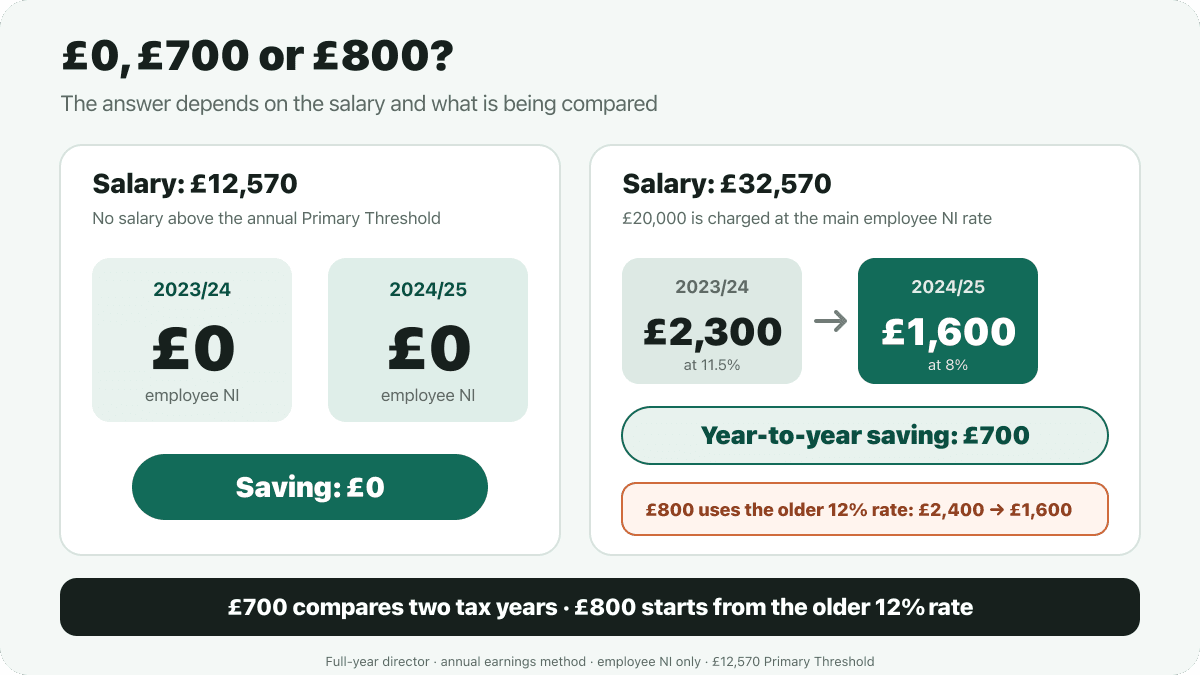
A full-year director paid £12,570 had no salary above the annual Primary Threshold in either 2023/24 or 2024/25. Their employee National Insurance bill was therefore £0 in both years. The employee-rate cuts did not create a saving at that salary.
This does not mean the salary was free of every company cost. Employer National Insurance is a separate charge with a different threshold. It was not reduced by these employee-rate changes.
At £32,570, the year-to-year saving was £700
Now take a full-year director paid £32,570. This is an illustration, not a recommended salary. With an annual Primary Threshold of £12,570, employee National Insurance applies to £20,000 of the salary in this example.
| Salary | Employee NI in 2023/24 | Employee NI in 2024/25 | Year-to-year saving |
|---|---|---|---|
| £12,570 | £0 | £0 | £0 |
| £32,570 | £2,300 | £1,600 | £700 |
The £2,300 figure is £20,000 × 11.5%. The 2024/25 figure is £20,000 × 8% = £1,600. Subtract one bill from the other and
the saving is £700.
The calculation uses the annual earnings method and assumes a full-year directorship, no earnings above the Upper Earnings Limit and no other pay. It covers employee National Insurance only; employer National Insurance and Income Tax are separate.
Where the £800 figure came from
Before 6 January 2024, the main employee National Insurance rate was 12%. Comparing that older rate directly with the new 8% rate gives a four-point reduction:
£20,000 × (12% − 8%) = £800
That calculation describes the change from the older 12% rate to 8%. It does not compare a director's final bill for 2023/24 with their bill for 2024/25, because the 12% rate did not remain in place for the whole of 2023/24.
Why directors had an 11.5% rate in 2023/24
The ordinary employee rate was 12% until 5 January 2024 and 10% from 6 January to 5 April 2024. Directors normally have an annual earnings period, so HMRC used a blended 11.5% main rate for their final 2023/24 annual calculation.
Some payrolls use the alternative director method and deduct National Insurance by pay period during the year. The final pay period must still reconcile the liability using the standard annual method. The alternative method can change when money is deducted, but not the final 2023/24 rate.
From 6 April 2024, the main employee rate was 8%. A full-year director therefore used 8% for 2024/25 on earnings between the annual Primary Threshold and Upper Earnings Limit.
What to compare before changing your salary
The employee NI saving is only one part of a salary decision. Salary can also create employer National Insurance, reduce taxable company profit, change Corporation Tax and leave more or less profit available for dividends.
Check the salary used in an example before relying on its saving. Then check whether it compares two complete tax years or simply compares the old 12% rate with 8%. Tax Shrink uses the 11.5% annual director rate for 2023/24 and 8% for 2024/25. The methodology explains the model boundaries. You can inspect employee NI in the personal-tax calculator or compare the wider company result in the salary-and-dividend calculator.
Continue with the company-wide comparison
The 2023/24 retrospective places the blended director rate alongside Corporation Tax, dividends and Scotland. The 2024/25 retrospective covers the first full year at 8%. The later 2025/26 employer NI guide explains why the company-side cost then became the more important salary change.